
AC drain pan overflow and ceiling damage
The stain on your ceiling is the last step in a process that usually started weeks earlier, in the attic above it.
Call For Help(972) 449-592524/7 emergency line. Free estimates from local pros.
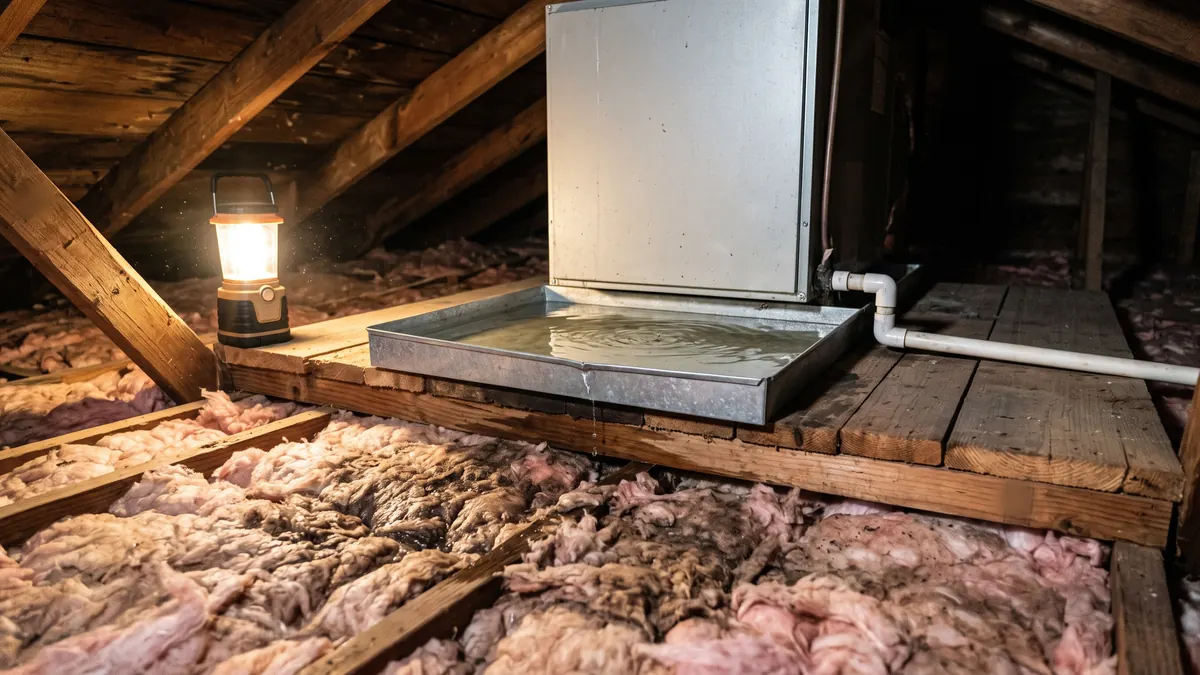
A ceiling stain that sits under or near an AC vent almost always traces back to the condensate line, not the roof and not a bathroom pipe overhead. By the time that stain shows up, the process behind it has usually been running in your attic for weeks already. Working backward from the stain to what actually caused it is the fastest way to understand what happened up there, and what it takes to fix.
Today: a stain that wasn’t there yesterday
A fresh AC-related stain usually shows up somewhere near the air handler, often after the system has run hard for a few hours. It can look faint at first, then darker and slightly soft to the touch the next time the unit runs. That stain is the visible tail end of something, not the beginning of it. The ceiling water damage page spot-checks the three ways a stain like this can end up, whether it started with an AC line or something else entirely.
Days before: the switch that should have caught it
Every properly working system has a float switch sitting in the drain pan for exactly one reason: to shut the unit down before the pan spills over. If that switch is stuck, worn out, wired wrong, or was never installed on your unit at all, it doesn’t do its one job. Water keeps rising in the pan with nothing there to stop it.
Weeks before: a pan filling out of sight
Before the switch ever came into play, the pan itself was already holding more than it should. It exists to catch the water dripping off the evaporator coil while the system runs, a small, steady amount that’s supposed to leave through the drain line as fast as it arrives. Once that line stops keeping up, the pan starts filling instead of draining, invisible from anywhere inside the house.
The real start: a line that slowly picked up algae
The condensate line is narrow, and it carries warm, damp water almost every day the AC runs. That’s the exact environment algae and sludge grow in. A line that drains fine in June can be noticeably slower by August, and fully blocked by the time the pan finally overflows. None of that is visible unless someone’s specifically looking for it, which is why the first sign most homeowners get is a stain on the ceiling, not a clogged line.
Two different calls, in a specific order
Clearing that line and replacing a failed switch is HVAC work, and it’s what stops the water from coming back. It doesn’t touch what the water already did to the ceiling or the insulation above it. Most jobs like this need both sides handled, and the HVAC side usually comes first, since there’s little point drying a ceiling that’s still catching fresh water from above.
An attic check, not a hallway guess
None of the parts involved in this, the pan, the switch, or the line, are visible from the hallway looking up. They all sit above the insulation, out of view from anywhere in the finished part of the house. A walkthrough gets someone up into the attic to look at what the ceiling can’t show, and to trace how far the water actually spread before it reached the spot you noticed. From there, how long the drying itself takes follows roughly the same pattern covered in the drying time guide, once the equipment is actually running.
The line gets cleared before the insulation does
An HVAC visit can clear the line and swap the switch in one trip, and once that’s done, the water stops arriving. But the insulation it soaked into over those weeks doesn’t dry just because the line is clear now. That part is often still wet days later, sitting in exactly the kind of conditions the mold after water damage guide models in more detail, long after the HVAC side of the job is already finished.
Common questions
Can I flush the condensate line myself to keep this from happening again?
Some homeowners do pour a cup of plain vinegar down the line a few times a year as basic upkeep, and it's a low-risk step. It won't undo a clog that's already built up or fix a switch that's already failed, though. Past that point, an HVAC technician is who actually clears the line and checks the switch.
Does a one-time overflow mean the whole line is clogged?
Not always. A single overflow can come from a switch that stuck or failed on its own, even with a line that's still mostly clear. It's common enough for both to be true at once that whoever looks at it usually checks the line and the switch together.
Is a stain right under the vent worse than one off to the side?
Not necessarily by location alone. What matters more is how long the ceiling sat wet and how far the water spread sideways before it ever reached a spot you could see from below. A stain off to the side can mean the water traveled further than one sitting directly under the vent.
Does this mean something is wrong with the AC unit itself, not just the drain?
Usually not the unit itself. The coil, the pan, the line, and the switch are the parts involved in an overflow, and none of those are the compressor or the parts that actually cool the air. The unit can keep running fine while this problem builds behind the scenes.
Related pages
Drying Time
Most jobs run several days, not one visit, and day three is usually when someone asks why the equipment is still there.
Learn more →Frozen pipe burst
What decade your Richardson house went up usually decides where it freezes first.
Learn more →Insurance Guide
Some water damage is covered, some isn't, and the split usually comes down to how fast it happened, not how bad it looks.
Learn more →Mold Guide
A mold assessor works from a short list of questions, not a guess, and the answers to those questions start piling up the day something gets wet.
Learn more →Talk to a local pro now
We answer 24/7. One call gets a Richardson crew moving on your water damage, with a free estimate and help with your insurance claim.
Call For Help(972) 449-5925Free estimates. No obligation to hire.